01Overview
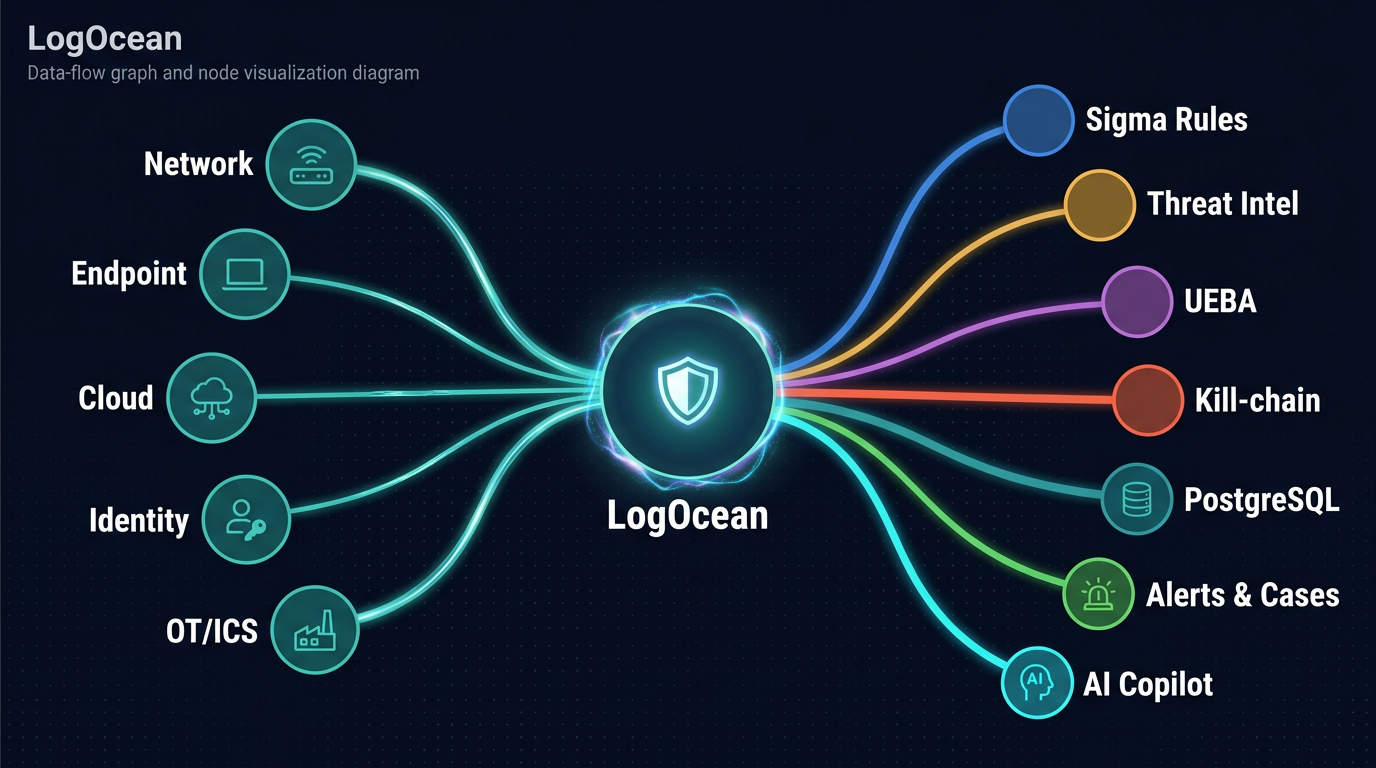
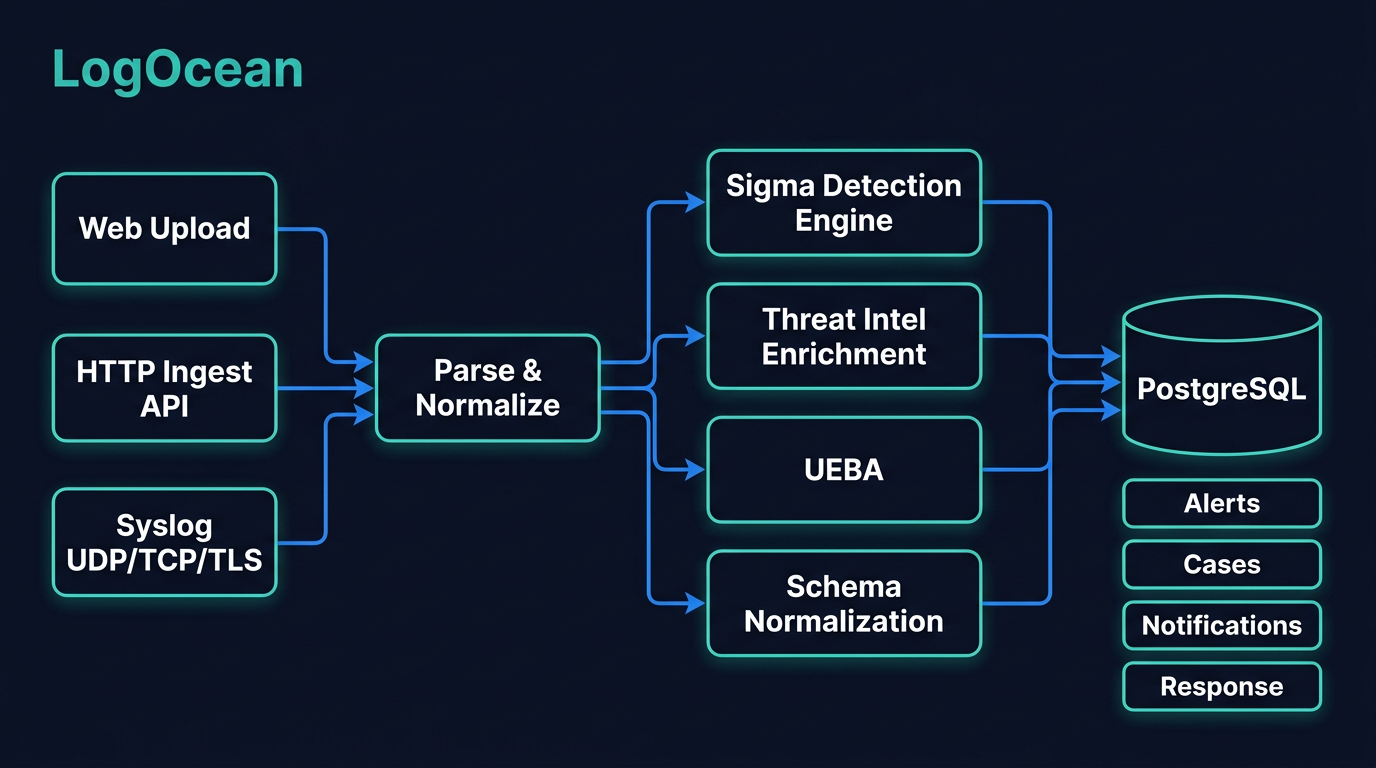
LogOcean is a self-hosted, agentless SIEM that ingests network, endpoint, cloud, identity, and OT/ICS logs from 29 vendors, auto-detects each format, normalizes every record to one common schema, and retains everything in PostgreSQL for three years or more. It takes logs through three front doors — a web upload page, an HTTP ingest API with API-key auth, and a syslog receiver (UDP/TCP/TLS) fronted by a bounded async queue — so a burst of live traffic never blocks the receiver. There are no agents to deploy: you point collectors, forwarders, and other tools at it.
Ingested events are matched inline against a Sigma-compatible detection engine (90 detection rules) while a background scheduler runs 10 correlation/threshold rules over the event store, raising alerts you triage at /alerts and group into cases. On top of the detection core sit the pieces a SOC actually needs: threat-intel IOC enrichment, webhook/email notifications, agentless response playbooks with time-boxed auto-revert, UEBA entity-risk scoring, kill-chain reconstruction that stitches related alerts into multi-tactic attack stories, and a detection-engineering workbench that maps coverage and flags noisy or dead rules.
What sets LogOcean apart is that its detection posture is measured, not asserted: a /coverage scoreboard computes MITRE ATT&CK (Enterprise + ICS) and MITRE ATLAS coverage directly from the rules, exports ATT&CK Navigator layers, and is enforced by a CI rule-linter. A community SigmaHQ importer translates the open rule corpus into the engine, and an optional Claude-powered SOC copilot explains alerts, summarizes cases, and drafts Sigma rules from plain English. Passive OT/ICS monitoring ingests Zeek + ICSNPP telemetry (Modbus/DNP3/S7comm/CIP) with an ATT&CK-for-ICS rule pack and IEC 62443 / NERC CIP mapping — without ever touching a device.
It is built for security engineers and small-to-mid SOC teams who want a real, auditable SIEM they fully control — no per-GB licensing, no cloud lock-in, no JavaScript build step. The whole stack is Python + FastAPI + PostgreSQL 16, server-rendered, and tested unit + integration against a real database in CI across Python 3.11–3.13.
02Key Capabilities
29 auto-detected vendor parsers
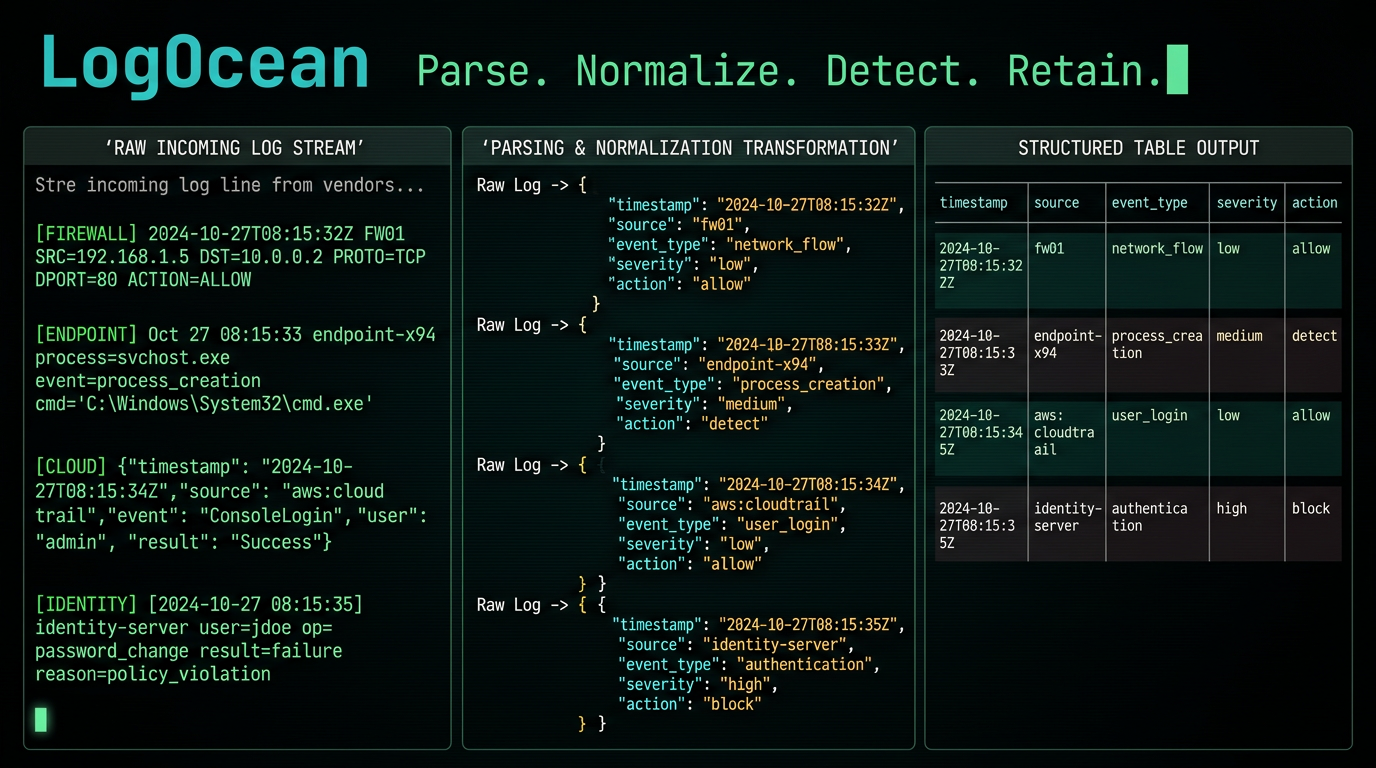
Ingests network, endpoint, cloud/identity, private-cloud (Nutanix), OT/ICS, and generic CEF/LEEF/syslog/JSON logs, auto-detecting the format on upload and normalizing every one to a single schema.
Three agentless ingest paths
Web upload, an HTTP ingest API with API-key auth and gzip/bomb-guarded bodies, and a UDP/TCP/TLS syslog receiver fronted by a bounded async queue so a burst never blocks intake.
Sigma-based detection & correlation engine
Ships 90 per-event detection rules plus 10 threshold/cardinality correlation rules, supporting the common Sigma modifiers (contains/cidr/base64offset/windash/fieldref) so many community rules load unmodified.
MITRE ATT&CK + ATLAS coverage scoreboard
A /coverage page computes Enterprise + ICS + ATLAS coverage from the rules themselves, rolled up by tactic, fidelity, and data source, with ATT&CK Navigator layer export and a CI rule-linter.
Community SigmaHQ importer
Translates thousands of open ATT&CK-tagged SigmaHQ rules into the engine by mapping Sigma logsource to a gate over normalized fields, honestly skipping anything it cannot faithfully run.
Triage, cases & saved searches
Acknowledge/assign/annotate alerts, build suppression/allowlist rules to cut noise, group related alerts into cases with severity roll-up, and save per-user queries as one-click chips.
Notifications & agentless response
Delivers new alerts to webhook/email channels and runs response playbooks that POST containment intents to your SOAR/firewall/IAM, with time-boxed auto-revert that fires the inverse action on expiry.
UEBA entity risk & kill-chain reconstruction
Pure-PostgreSQL behavioural analytics baseline every user/host/IP for new-entity/new-association anomalies and stitch related alerts across ATT&CK tactics into narrated attack stories.
AI SOC copilot (Claude)
Optional, off-by-default assistant that explains alerts, summarizes cases in ATT&CK order, and drafts Sigma-subset rules from natural language, all RBAC-gated and audited.
Passive OT/ICS monitoring
Enriches Zeek + ICSNPP telemetry (Modbus/DNP3/S7comm/CIP) into a control-plane action + ot.* fields, with an ATT&CK-for-ICS rule pack, controller asset inventory, and master to controller baselining.
Partitioned PostgreSQL storage with 3-year retention
Events are RANGE-partitioned by month with GIN full-text + jsonb indexes; purge is an instant partition drop and re-ingesting the same file is idempotent via a dedup hash.
Auth, RBAC & audit trail
Built-in login with admin/analyst/viewer roles, pbkdf2 passwords, server-side sessions, security headers + CSRF, a last-admin lockout guard, and an audit log of every security-relevant action.
03Architecture
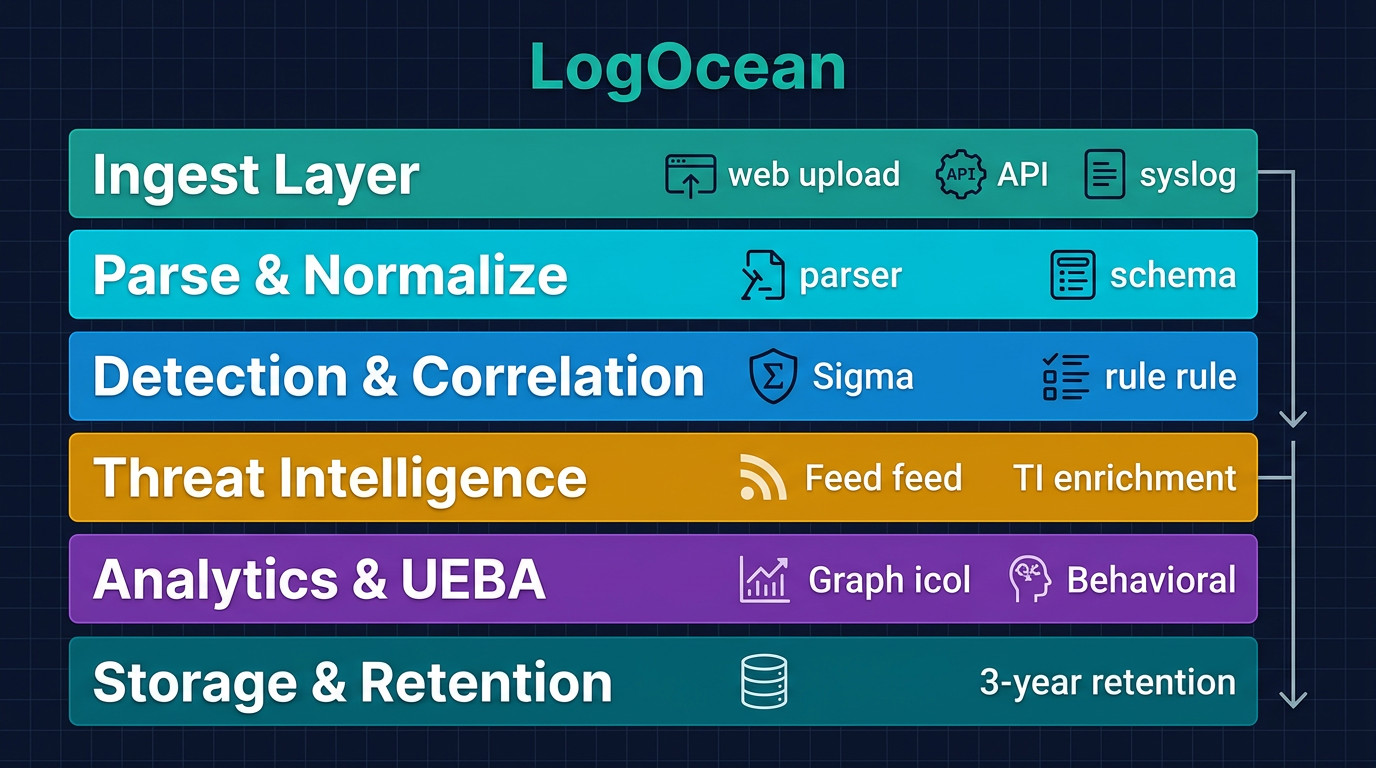
Three ingest inputs share one source-agnostic core pipeline: detect format, parse with a vendor parser, normalize to a common NormalizedEvent schema, and store in month-partitioned PostgreSQL. Live sources buffer in a bounded async queue drained by batching writer workers. Every event is evaluated inline against per-event detection + threat-intel rules and updates UEBA baselines as it is stored, while a background scheduler runs correlation SQL over the event store; both raise rows in the alerts table that fan out to notifications and agentless response.
04Project Structure
app/main.pyFastAPI routes, server-rendered Jinja2 UI, and application lifespan wiring.app/pipeline.pySource-agnostic parse to normalize to insert core, with inline detection, threat-intel, and UEBA baselining.app/parsers/29 vendor/format parsers plus the zeek_ics OT/ICS enrichment helper.app/detection/Sigma-subset per-event engine, correlation/threshold engine, and the rule-registry runtime.app/coverage.pyPure ATT&CK (Enterprise + ICS) + ATLAS detection-coverage scoreboard computed from the rules.app/collectors/Agentless pull connectors (Okta/GitHub/GitLab/AWS/Entra/M365/GCP) plus the polling scheduler.rules/90 detection + 10 correlation Sigma-subset YAML rules, plus imported/ for generated SigmaHQ imports.playbooks/Agentless response playbooks (match + action YAML) including block-brute-force and log-high-severity.schema.sqlPartitioned events table, FTS/jsonb/btree indexes, and all supporting tables (alerts, cases, iocs, users...).scripts/import_sigma.pyCLI that translates a SigmaHQ clone into rules/imported/*.yml for the engine.tests/Unit (DB-free) and integration (real Postgres) tiers — 303 test functions across 32 files.docs/DETECTION_COVERAGE_ROADMAP.mdLiving, phased detection-coverage programme plan.05Security Controls
06Technology Stack
- Language
- Python 3.11–3.13
- Web framework
- FastAPI + Uvicorn, Jinja2 server-rendered UI (no JS build step, no chart library)
- Database
- PostgreSQL 16 via psycopg 3 (+ psycopg_pool), RANGE-partitioned with GIN full-text/jsonb indexes
- Key dependencies
- pyyaml (rules), python-dateutil (time parsing), python-multipart (uploads); anthropic optional for the AI copilot
- Testing
- pytest — 303 test functions across a DB-free unit tier and a real-Postgres integration tier
- CI
- GitHub Actions (.github/workflows/tests.yml): unit matrix on Python 3.11/3.12/3.13 + integration job against a Postgres 16 service container
- Deployment
- docker compose (Postgres + app) or local uvicorn; schema auto-created on startup
- Auth/crypto
- Stdlib-only pbkdf2 password hashing; AWS SigV4, OAuth2 client-credentials, and RS256 signed-JWT auth for collectors without SDKs
07Quick Start
$ docker compose up --build   # starts Postgres + the app, then open http://localhost:8000 and upload a file from samples/
$ export DB_DSN=postgresql://logocean:logocean@localhost:5432/logocean && uvicorn app.main:app --reload   # local run; schema auto-creates on startup
$ curl -X POST 'http://localhost:8000/api/v1/ingest?format=auto&filename=fw.log' -H 'X-API-Key: lo_...' --data-binary @fw.log   # HTTP ingest API
$ SYSLOG_ENABLED=true   # listen on UDP+TCP 5514, then point a collector/device at the syslog receiver
$ git clone https://github.com/SigmaHQ/sigma && python scripts/import_sigma.py --src sigma/rules --write   # import community rules, then restart to load
$ PYTHONPATH=. python -m pytest tests/ -m 'not integration' -q   # run the DB-free unit tier
08Compliance & Frameworks
09Integrations & Outputs
Explore LogOcean
Full source, documentation, and deployment guides live on GitHub.