A Risk-Based Approach to
Enterprise Cybersecurity

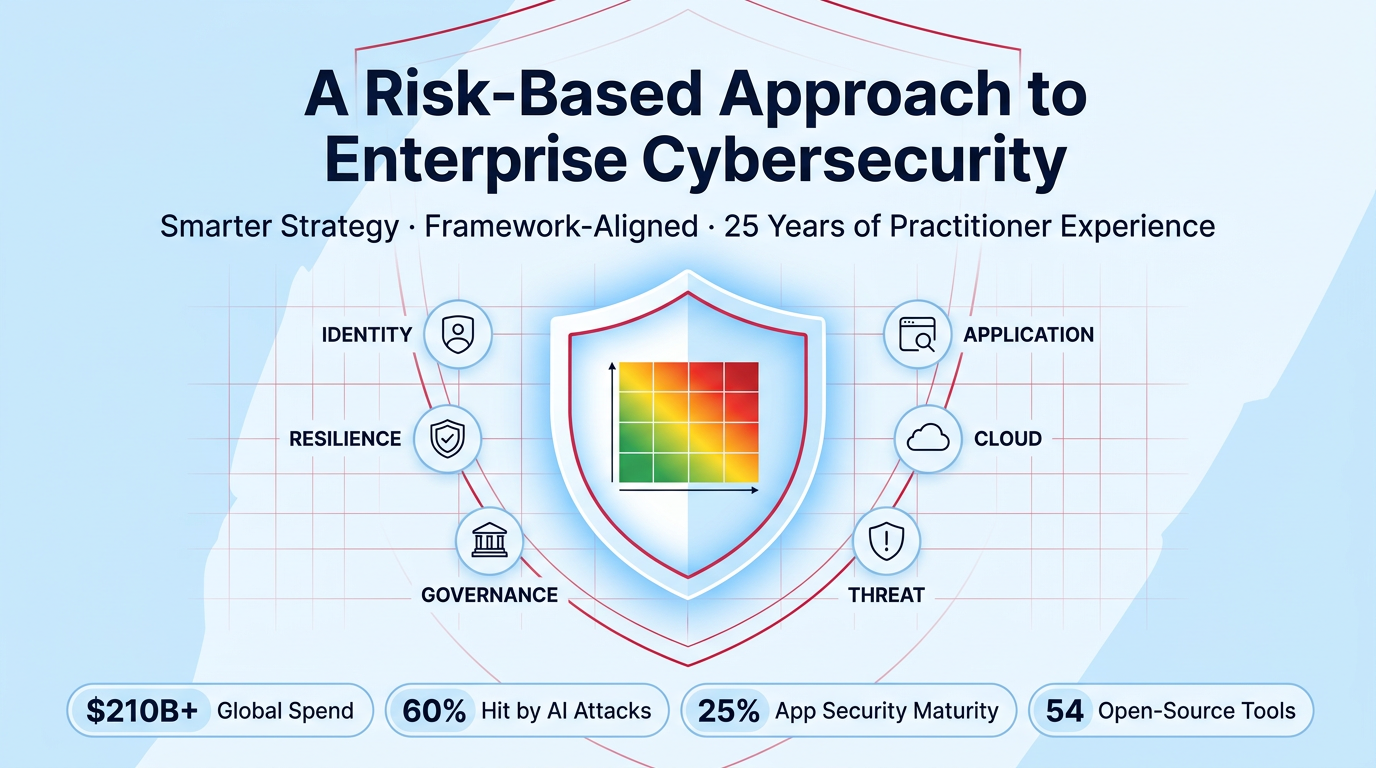
Organizations spent over $200 billion on cybersecurity in 2024, yet breaches continue to rise. The answer is not more spending — it is smarter strategy. This page presents a comprehensive, framework-aligned cybersecurity strategy informed by industry research, global standards, and 24 years of practitioner experience.

Why Cybersecurity Strategy Must Evolve

The digital attack surface has expanded exponentially. Cloud adoption, remote work, IoT proliferation, AI-powered attacks, and third-party dependencies have rendered perimeter-based security obsolete. Organizations need a risk-based, resilience-first approach.

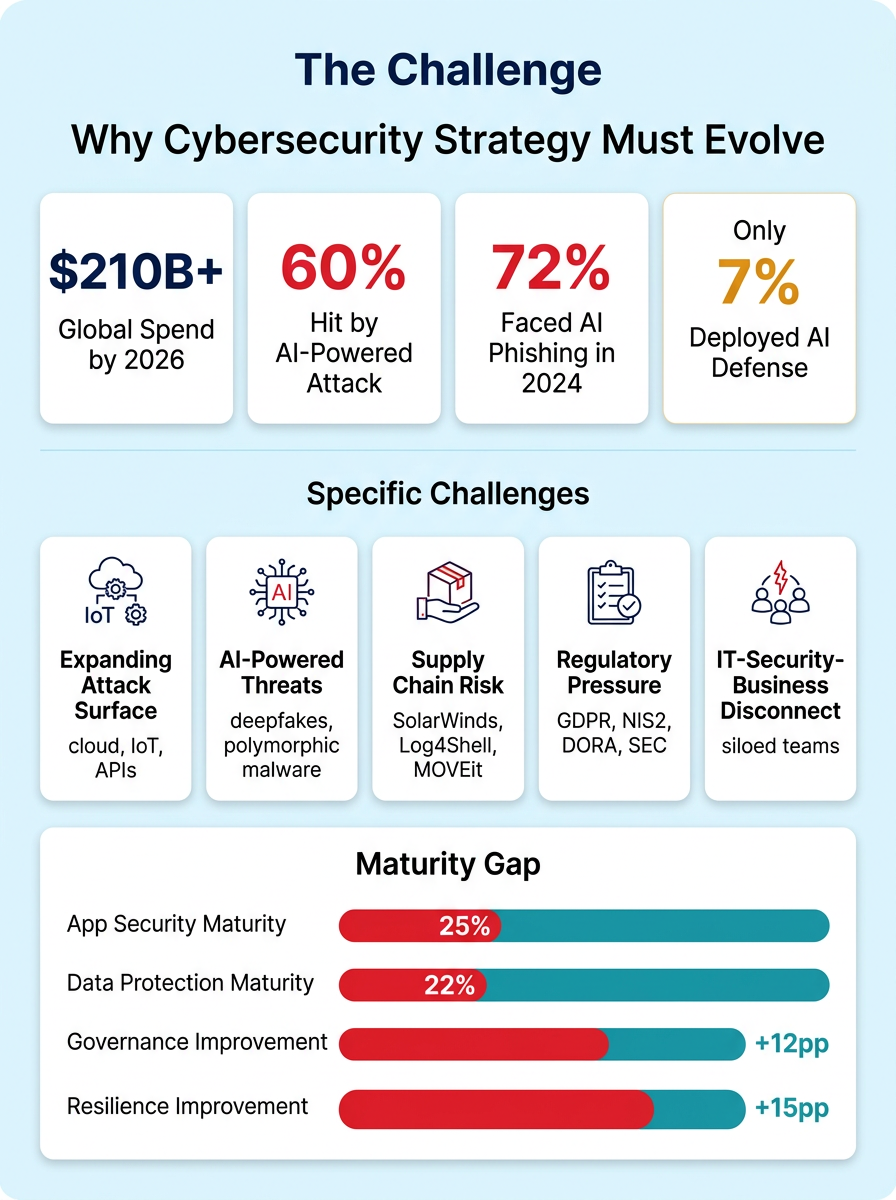
$210B+ Global cybersecurity spend projected by 2026
60% Companies experienced an AI-powered cyberattack in the past year
72% Firms faced AI-powered phishing attacks in 2024
7% Companies have actually deployed AI-enabled defense tools
Expanding Attack Surface
Cloud workloads, remote endpoints, IoT devices, and third-party integrations have dissolved the traditional security perimeter. Every API, SaaS tenant, and container is now a potential entry point. Organizations running 40–70 security tools simultaneously face complexity that is itself a vulnerability.
AI-Powered Threats
Adversaries are leveraging generative AI for sophisticated phishing, polymorphic malware, deepfakes, and automated vulnerability exploitation. A $25 million fraud was triggered by a deepfake video call impersonating a CFO. Yet 69% of organizations report difficulty hiring talent with AI-cybersecurity expertise.
🔗
Supply Chain & Third-Party Risk
SolarWinds, Log4Shell, and MOVEit demonstrated that third-party and software supply chain attacks can bypass even mature security programs. Only 28% of companies achieve the highest maturity score in third-party cyber risk management. Vendor risk is now a board-level concern.
📄
Regulatory Pressure
GDPR, NIS2, DORA, SEC cyber disclosure rules, and cross-border data flow regulations have raised the stakes for non-compliance from reputational damage to existential fines. Tougher regulatory oversight and soaring breach costs are elevating cybersecurity to the boardroom agenda.
🛠
The IT-Security-Business Disconnect
Digital innovations often outpace the measures companies take to safeguard their systems. IT teams, cybersecurity experts, and business leaders operate with different goals, work independently, and speak different languages. Many leaders still treat cybersecurity as an IT line item rather than a strategic imperative.
📈
Maturity Gaps Persist
Despite growing investment, only 25% of companies achieve highest maturity in application security, and only 22% do so in data protection or software supply chain risk management. The gap between compliance checkbox and actual resilience remains dangerously wide.

Where Organizations Stand Today

Global cybersecurity surveys reveal that while overall maturity is improving, critical gaps remain. The biggest gains have been in governance and resilience — but offensive capabilities and AI adoption are lagging dangerously behind the threat landscape.

+12pp
Improvement in cybersecurity governance, risk & compliance
+15pp
Improvement in business continuity & resilience scores
25%
Achieved highest maturity in application security
22%
Achieved highest maturity in data protection

Three Mandates for Cybersecurity Transformation

Industry research with the world's largest organizations has revealed three broad mandates that drive effective cybersecurity transformation — shifting from maturity-based checklists to a risk-based, resilience-first model.

1. Prioritize Risk
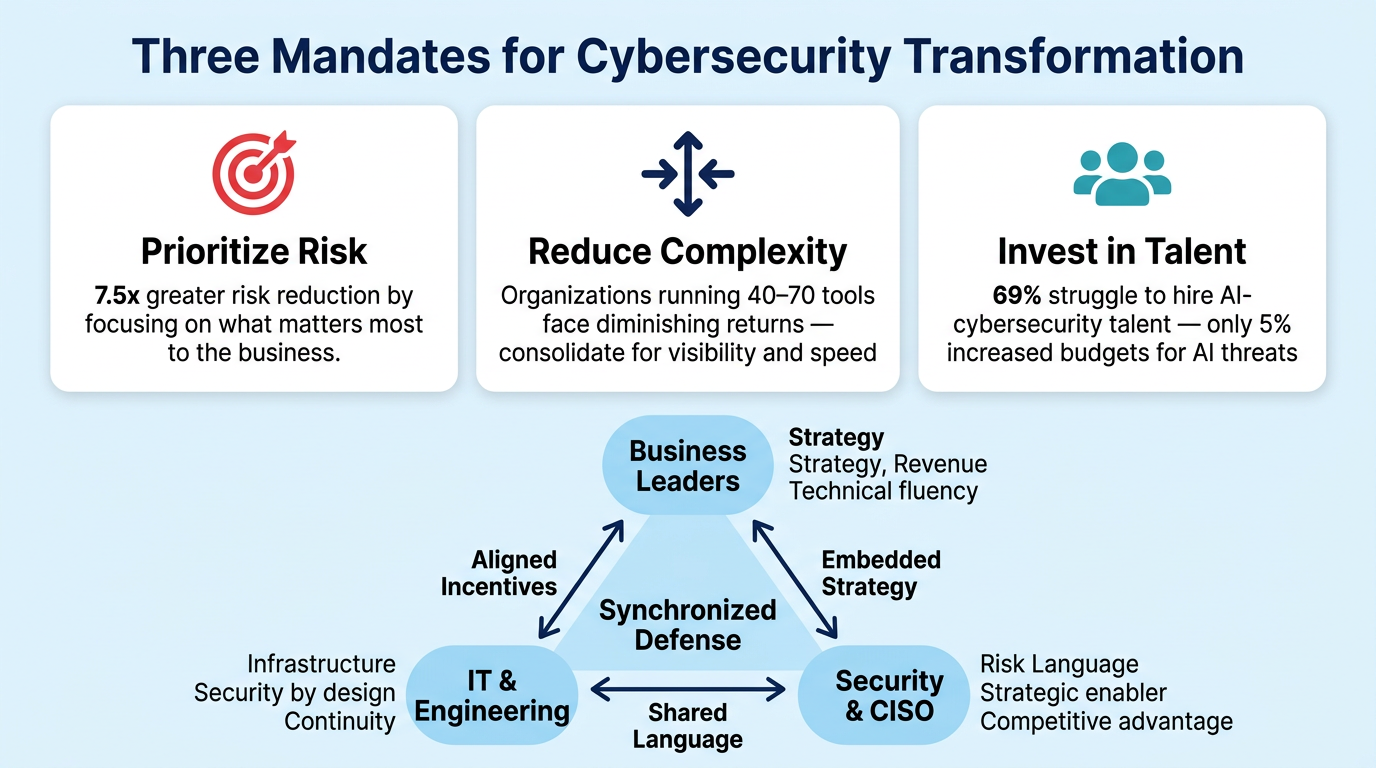
Stop trying to protect everything equally. Identify where the business creates value, analyze the threat landscape against those assets, and allocate security investment where risk reduction is greatest. Companies that adopt risk-based strategies outperform because they protect what matters most.
Organizations that reorder security initiatives according to a risk-based approach have achieved up to 7.5× greater risk reduction at no added cost — simply by focusing on what matters most to the business.
2. Reduce Complexity
Standardize and codify infrastructure, consolidate security vendors, and automate control-engineering processes. The industry trend toward vendor consolidation has accelerated, with more organizations planning to reduce their security tool sprawl than expand it.
Complexity is the enemy of security. Organizations running 40–70 security tools simultaneously face diminishing returns. Consolidation delivers better visibility, faster response, and lower operational cost.
3. Invest in Talent
Use a talent-to-value protection approach: identify the roles that reduce the most risk, fill them first, and align security hiring to business growth aspirations. The CISO must evolve from technologist to business partner who brings operational context to risk.
69% of organizations report difficulty hiring talent with AI-cybersecurity expertise. Only 5% have significantly increased cybersecurity budgets in response to AI-driven threats — a dangerous gap.

Aligning Business, IT & Security Teams

The most effective cybersecurity organizations are not defined by their tools — they are defined by the alignment between their business leaders, IT teams, and security functions. Cybersecurity must be reframed as a business discipline, not a technical silo.

🎓
Business Leaders
Focus on strategic priorities: revenue growth, customer engagement, and operational efficiency. Must develop technical fluency to assess risks and prioritize investments — rather than over-relying on IT and security teams without sufficient oversight.
IT & Engineering
Own the infrastructure, platforms, and development pipelines. Must embed security by design into every architecture decision, coordinate IT recovery with business continuity, and operate with centralized accountability.
🛡
Security & CISO
Evolve from a technical gatekeeper to a strategic enabler. The CISO must communicate risk in the language of the business, align security investments to value creation, and position cybersecurity as a competitive advantage — not a brake on innovation.

The synchronized approach: Align incentives across business, IT, and security. Embed cybersecurity and resiliency within the broader business strategy. Protect the most critical business services, test risk scenarios, and ensure effective training, awareness, and communication. This is a people and organization challenge as much as a technical one.

Six Pillars of a Modern Cyber Defense

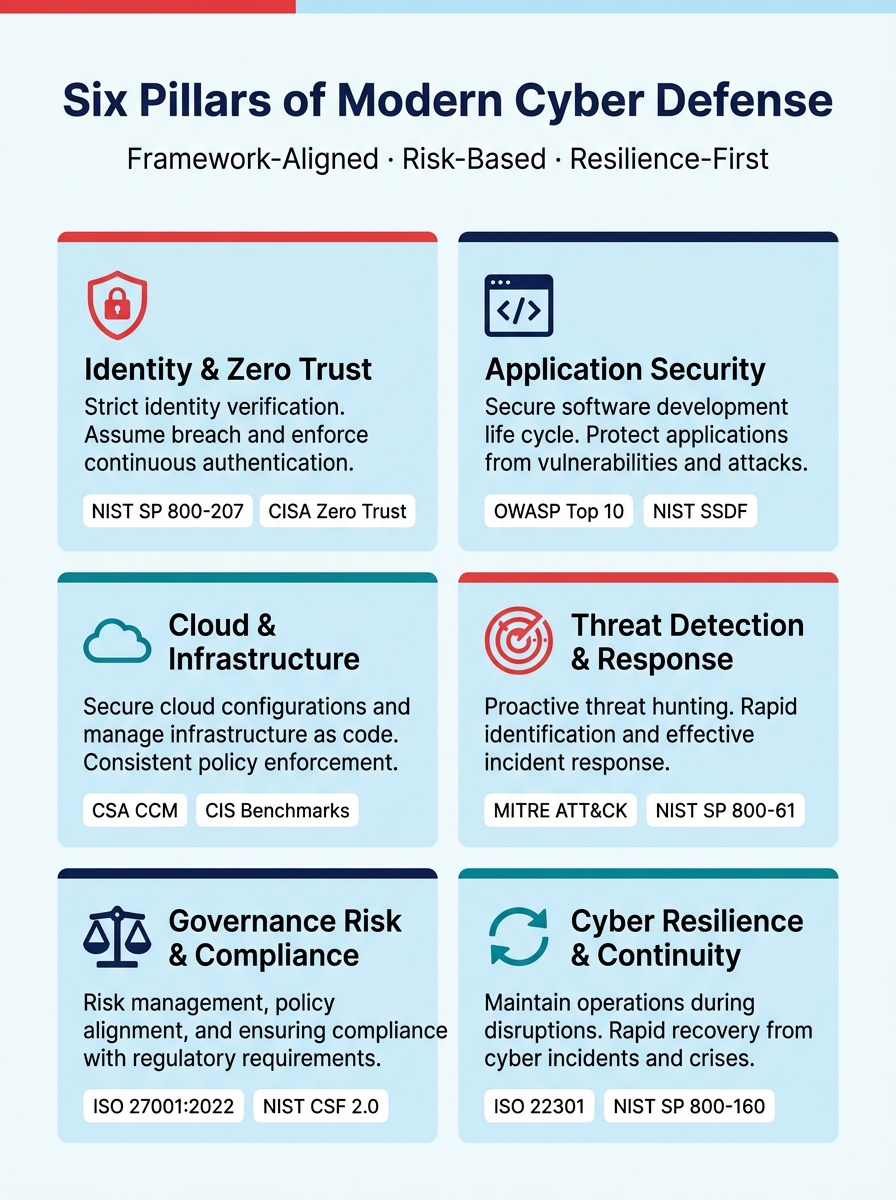
A comprehensive cybersecurity strategy must address six interconnected domains. Each pillar maps to industry frameworks and is supported by open-source tools from the Phalanx Cyber collection.

🔒
Identity & Zero Trust
Shift from perimeter-based to identity-centric security. Every user, device, and workload must be continuously verified. Zero Trust Architecture enforces least-privilege access with granular policies. Projected spend on zero-trust network access is growing 10%+ annually.
  • NIST SP 800-207 (Zero Trust Architecture)
  • CISA Zero Trust Maturity Model
  • Microsoft Entra ID / Conditional Access
  • Tool: M365 SSPM Scanner
💻
Application Security
Shift security left into the development lifecycle. Static analysis (SAST), dynamic testing (DAST), API security, and software composition analysis must be embedded into CI/CD pipelines. Only 25% of organizations achieve highest maturity here.
  • OWASP Top 10 (Web, API, LLM)
  • NIST SSDF (Secure Software Development)
  • CWE / SANS Top 25
  • Tools: SAST, DAST, API Security Scanner
Cloud & Infrastructure Security
Secure cloud workloads, containers, and hybrid infrastructure with CSPM, KSPM, and CIS hardening. Misconfiguration remains the #1 cloud breach vector. Many organizations lack strong central oversight and governance of cloud use.
  • CSA Cloud Controls Matrix (CCM)
  • CIS Benchmarks (AWS, Azure, GCP, K8s)
  • ISO 27017 / ISO 27018
  • Tools: AWS, Azure, GCP, KSPM Scanners
🚨
Threat Detection & Response
Build adversary-informed detection capabilities. Map detection rules to MITRE ATT&CK techniques, operationalize threat intelligence, and build playbooks for rapid incident response. AI-augmented SOC operations are becoming essential to match the speed of AI-powered attacks.
  • MITRE ATT&CK Framework
  • NIST SP 800-61 (Incident Response)
  • Sigma / KQL Detection Rules
  • Tools: Detection Engineering, CDR Scanner
Governance, Risk & Compliance
Establish a risk governance framework that connects security controls to business outcomes. Cyber-mature organizations distinguish themselves through increased accountability, centralized decision-making, and coordination between IT recovery and business continuity.
  • ISO 27001:2022 / ISO 27002
  • NIST CSF 2.0 (Govern, Identify, Protect, Detect, Respond, Recover)
  • GDPR / NIS2 / DORA / SOC 2
  • PCI DSS v4.0 / HIPAA
🛡
Cyber Resilience & Continuity
Assume breach. Build resilience through robust backup, disaster recovery, business continuity planning, tabletop exercises, and the ability to operate through a cyber event. A risk-based approach provides precision over blanket coverage, focusing on critical systems to deliver resilience without slowing innovation.
  • NIST SP 800-34 (Contingency Planning)
  • ISO 22301 (Business Continuity)
  • MITRE D3FEND / MITRE Engage
  • NIST SP 800-160 (Cyber Resiliency)

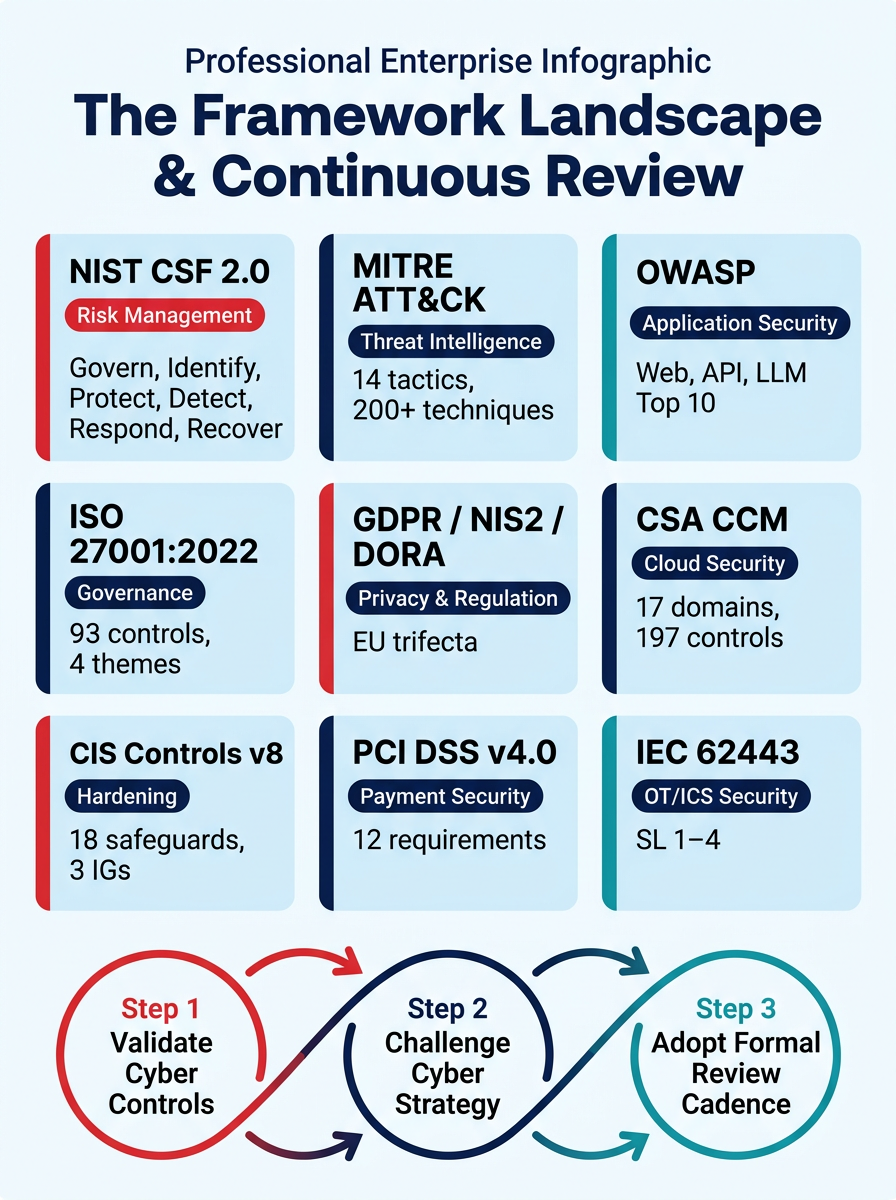
The Framework Landscape

No single framework covers every dimension of cybersecurity. A mature strategy layers multiple frameworks — each addressing specific domains, audiences, and regulatory requirements.

Risk Management
NIST Cybersecurity Framework 2.0
The gold standard for enterprise cybersecurity governance. CSF 2.0 adds "Govern" as a sixth core function, elevating cybersecurity to board-level strategic discussion.
Core Functions: Govern · Identify · Protect · Detect · Respond · Recover
Threat Intelligence
MITRE ATT&CK Framework
A globally-accessible knowledge base of adversary tactics, techniques, and procedures (TTPs). The foundation for adversary-informed defense and detection engineering.
Coverage: 14 Tactics · 200+ Techniques · Enterprise, Mobile, ICS matrices
Application Security
OWASP Foundation
The definitive resource for application security. OWASP Top 10 projects cover web, API, mobile, LLM, and serverless security risks with prescriptive remediation guidance.
Projects: Web Top 10 · API Top 10 · LLM Top 10 · ASVS · SAMM · Testing Guide
Governance
ISO/IEC 27001:2022
The international standard for Information Security Management Systems (ISMS). Provides a systematic approach to managing sensitive information through risk assessment and control implementation.
Controls: 93 controls across 4 themes (Organizational, People, Physical, Technological)
Privacy & Data Protection
GDPR / NIS2 / DORA
The EU's regulatory trifecta for cybersecurity and data protection. GDPR governs data privacy, NIS2 mandates security for essential services, and DORA ensures digital operational resilience for financial services.
Scope: Data Protection · Incident Reporting · Supply Chain Security · Operational Resilience
Cloud Security
Cloud Security Alliance (CSA)
The Cloud Controls Matrix (CCM) and STAR program provide a cloud-specific security governance framework. CAIQ and CCM map to ISO 27001, NIST, and PCI DSS for cross-framework alignment.
Domains: 17 control domains · 197 control specifications · STAR Levels 1–3
Hardening
CIS Benchmarks & Controls
Prescriptive hardening guides for 100+ technology platforms. CIS Controls v8 provides 18 prioritized safeguards organized into three Implementation Groups (IG1, IG2, IG3).
Coverage: OS · Cloud · Network · Database · Containers · SaaS · Mobile
Payment Security
PCI DSS v4.0
The payment industry's security standard for organizations handling cardholder data. v4.0 introduces customized approach validation and continuous security process requirements.
Requirements: 12 principal requirements · 6 objectives · Customized validation approach
OT / ICS Security
IEC 62443
The standard for Industrial Automation and Control Systems (IACS) security. Defines security levels for zones and conduits in operational technology environments, from power grids to manufacturing floors.
Structure: General · Policies & Procedures · System · Component levels (SL 1–4)

OEM Security Frameworks & Well-Architected

Each major cloud provider offers a security-focused well-architected framework. These are not marketing material — they are engineering playbooks for building secure, resilient, and cost-efficient cloud environments.

AWS Well-Architected
Security Pillar
Prescriptive guidance for securing AWS workloads across identity, detection, infrastructure protection, data protection, and incident response.
IAM Detection Infra Protection Data Protection Incident Response
Azure Well-Architected
Security Pillar
Microsoft's framework for designing secure Azure solutions, integrating Defender, Entra ID, Sentinel, and Azure Policy for comprehensive cloud posture management.
Zero Trust Defense in Depth Governance DevSecOps Monitoring
Google Cloud
Architecture Framework
Google's security blueprint emphasizing BeyondCorp (zero trust), workload identity federation, VPC service controls, and Security Command Center integration.
BeyondCorp Workload Identity VPC Controls SCC Org Policies

Strategy is Not a One-Time Event

Leading organizations adopt a three-step continuous review process to ensure cybersecurity strategy remains aligned to evolving threats, business priorities, and technology capabilities.

Validate Cyber Controls
Continuously test and validate that existing security controls are effective against the current threat landscape. Red team exercises, breach simulation, and control validation ensure readiness — not just compliance.
Tools: CrowdStrike Red Team Validation, CrowdStrike Falcon EDR Scanner, Detection Engineering (Sigma/KQL)
Challenge Cyber Strategy
Regularly refresh your cybersecurity road map by evaluating emerging capabilities: AI-augmented SOC, CNAPP convergence, identity-first security, and automated remediation. Challenge assumptions quarterly. Reframe cybersecurity as an enabler of growth, not a brake on innovation.
Frameworks: NIST CSF 2.0, ISO 27001:2022, CIS Controls v8, MITRE ATT&CK Navigator
Adopt Formal Review Cadence
Establish a formal program to continually review cyberstrategy, technologies, and processes at board level. The conversation must move beyond the server room to the boardroom — and the mindset must catch up with the stakes.
Board Agenda: Cyber risk appetite · Investment prioritization · Incident readiness · Regulatory posture · Third-party exposure

From Strategy to Execution

Every strategic pillar above can be operationalized with the Phalanx Cyber open-source tool collection. 29 scanners, 4,500+ rules across 15+ compliance frameworks, zero licensing cost.

Strategy Without Execution is Hallucination
Browse the complete collection of open-source security scanners that operationalize every pillar of this cybersecurity strategy — from SAST to CSPM to detection engineering.
Browse All Tools View on GitHub

Frameworks & Standards Referenced

The strategic frameworks and industry data referenced on this page are drawn from the following authoritative sources.

NIST Cybersecurity Framework 2.0 (February 2024)
NIST SP 800-207 — Zero Trust Architecture
NIST SP 800-61 — Incident Response
NIST SP 800-160 — Cyber Resiliency
MITRE ATT&CK Framework v15
MITRE D3FEND & MITRE Engage
OWASP Top 10 (Web, API, LLM) & OWASP SAMM
ISO/IEC 27001:2022 & ISO/IEC 27002:2022
ISO 22301 — Business Continuity Management
Cloud Security Alliance — CCM v4 & STAR Program
AWS Well-Architected Framework — Security Pillar
Azure Well-Architected Framework — Security Pillar
Google Cloud Architecture Framework — Security
IEC 62443 — Industrial Cybersecurity Standard
PCI DSS v4.0 & CIS Controls v8 / CIS Benchmarks
EU GDPR / NIS2 Directive / DORA Regulation
CISA Zero Trust Maturity Model
SANS / CWE Top 25 Most Dangerous Software Weaknesses